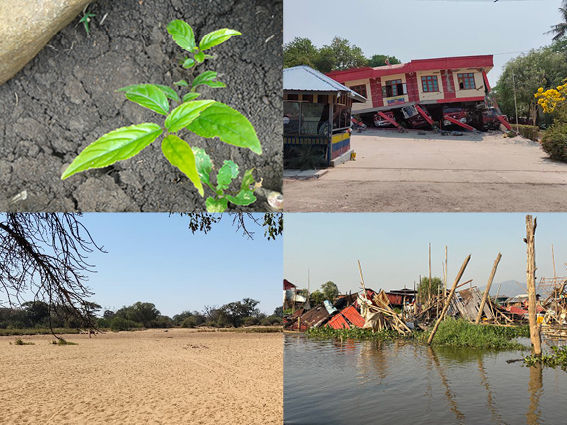
The El Niño Series: A Call for Climate Justice
El Niño is making headlines around the world, but what does it actually mean for communities already living with the effects of the climate crisis? In this series, we explore what El Niño is, why it matters, how All We Can's partners are responding, and what it means for people of faith committed to climate justice.
As many of us in the UK have recently experience our fifth heatwave of the summer, Jack Slater-Wells, the Net Zero Engagement Officer for the Methodist Church in Britain, writes about how this should be a wake-up call for all of us. The crisis related to changing weather requires us to reflect on and engage with climate justice.
If you've been moved or inspired by this series, please consider making a donation to the Emergency Relief Fund so All We Can can provide extra funding to partners to specifically help with climate preparedness.

A Call for Climate Justice
by Jack Slater-Wells

Great Britain is, famously, a rainy island. But the prevailing weather conditions in recent months have forced many of us to reconsider whether this will remain the case in a warming world. Like much of Europe, the summer of 2026 has been marked by exceptional heat, unprecedentedly low rainfall, and wildfires. While warm and dry conditions are not new, the science is clear that climate change has made this summer hotter and dryer that it would otherwise be. The numbers paint a dramatic picture of the situation. The average temperature in June was almost 3C above average for England. In July, Wales received just 8% of its average rainfall. In Scotland, a wildfire in the Cairngorms burned for almost two weeks and destroyed 25 square kilometres of forest and moorland. Perhaps most significantly, it is estimated that the heatwaves of June and July have resulted in almost 3,000 deaths. We once talked about the climate crisis in the future tense, as a scary and unknown future on our horizon. It is now undeniable that the climate crisis is here.
"Methodist churches have installed solar panels, switched to heat-pumps, improved the insulation of their buildings, and taken many other steps to reducing the greenhouse gas emissions associated with their buildings."
In the Methodist Church we are committed to reducing our contribution to this crisis by taking all reasonable steps to become a net-zero Church. Methodist churches have installed solar panels, switched to heat-pumps, improved the insulation of their buildings, and taken many other steps to reducing the greenhouse gas emissions associated with their buildings. Some churches have changed who they bank with, others have made greater use of online meetings. Worship schema and liturgies have been developed that put care for creation front and centre. Millions of pounds have been mobilised for climate action, and a growing number of districts employ staff whose sole focus is emissions reduction.
Of course, the Methodist Church is fundamentally nothing more or less than the sum of the people who make it up. And in countless different ways, we have all been working to reduce our emissions in our own lives: taking public transport, eating less meat, flying less, recycling our waste. We can see the outline of what a net-zero Methodist Church will look like. It is not here yet, but there is a trace of what the future will be that we can discern in the present.
And yet, we know we must move faster to make that hoped-for future a reality. As serious as the situation is here in Britain, the urgency of the climate crisis in other parts of the world is even greater. This injustice is compounded when we consider that many of those most affected by the climate crisis have done the least to cause it.
"As serious as the situation is here in Britain, the urgency of the climate crisis in other parts of the world is even greater. This injustice is compounded when we consider that many of those most affected by the climate crisis have done the least to cause it."
The summer of 2026 should be a wake-up call for those of us in Britain. The climate crisis has arrived, and if we are serious when we say we are called to do justice then climate action must be central to everything we do.
The climate crisis means that our partners need to help their communities face new challenges. If you would like to support this area of our work, and would like to see our partners better equipped for working in sustainable disaster resilience, please consider donating to our Emergency Relief Fund.